
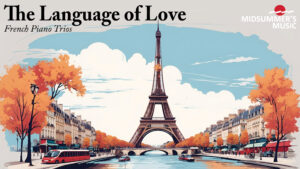
 Our new program, “The Language of Love,” starts this Saturday evening at St. Luke’s Episcopal Church in Sister Bay, and it is not for the faint-of-heart! Three late-romantic French pieces make up the program, and they conspire to get at the essence of love and romance. In fact, the first work on the program is called Romance sans parole (Romance without words). By Félix Fourdrain, it’s a rather short but passionate piece for violin, cello, and piano. It’s funny how sounds can convey so much even without words, or maybe especially so. Think about how much a sigh, a murmur, a little cooing, can tell you, especially in the right circumstance. That’s how we communicate with babies, and they with us. It’s very direct and efficient. Words just get in the way. Hence, a song without words to begin the program.
Perhaps that is why opera is so effective. You have words, but so much more is added emotionally with the music. You can sense the anger, the passion, the desire, the longing so much more intensely and directly with music insinuating it. And speaking of opera, that’s an important issue since we are talking about French music on this program. You see, in the early and even mid-19th century, the French were completely entranced with opera. They seemed to know of no other form of music. They weren’t interested in symphonic music and especially not at all in chamber music. Fortunately, a small cadre of composers, performers, and music lovers gathered together in intimate societies to perform and enjoy private moments of very special chamber music. As the 19th century moved into its last half, these various efforts gained steam and French chamber music started to flourish and bear fruit.
 Among the earlier musicians in this movement, we find Camille Saint-Saëns, Louise Farrenc, and George Onslow. However, eventually César Franck, Gabriel Fauré, and our other two composers on this program, Édouard Lalo and Ernest Chausson, joined them, followed by Debussy and Ravel. Soon, French chamber music was flourishing and was developing its own unique language. Extracting themselves from the dominance of German influence in earlier efforts, these composers were finding a freer, more expressive voice that allowed a wider and more compelling range of emotions.
Lalo and Chausson are perfect examples of this. It is telling that the first movement of Lalo’s Piano Trio in A minor is marked appassionato (passionately) just like Fourdrain’s Romance. Lalo’s palette is further enhanced by a Spanish element in his heritage (as his name implies). This work has been described as “powerful, rich, epic…” and it doesn’t disappoint. The same can be said of Chausson’s Piano Trio. His use of cyclic material is impressive in demonstrating how a germ of a melodic idea can be transformed throughout the work in many different guises and moods until it finally is synthesized into a dramatic ending.
These works will be played by three of the finest musicians you could hope to hear in one room: David Perry, violin; Mara McClain, cello; and Jeannie Yu, piano. Yet, as good as they are as individual musicians, their synergy en trio is simply remarkable and not to be missed.
Performances are …
July 19, 7:00 pm – St. Luke’s Episcopal Church, Sister Bay
July 20, 4:00 pm – Hope United Church of Christ, Sturgeon Bay
July 25, 7:00 pm – Unitarian Universalist Fellowship, Ephraim
July 26, 7:00 pm – Shepherd of the Bay Lutheran Church, Ellison Bay
Call 920-854-7088 or visit www.midsummersmusic.com for tickets or more information.